



Below you will find a selection of the most recent entries from bloggers in our Work/Business section.
To view the entries from individual bloggers, click on the links below:
- Claire Doole - Claire Doole Communications
Claire is a former BBC correspondent and international spokeswoman who is passionate about helping people communicate with confidence. Since 2006, she has successfully trained hundreds of professionals in the art of presenting and public speaking, talking to the media, managing communications in a crisis, and writing for the web. In addition, she has coached C-level executives and public figures to give powerful TEDx and TED style talks in Europe and the Middle East. A Swiss and UK national, Claire trains and coaches in French and English.
- Elizabeth Ballin - Life Coach
As a long time member of the international community in Geneva, Elizabeth Ballin has been coaching adults and students from all parts of the world. She has coached business professionals, musicians/artists, couples, families and adolescents. She is a fully accredited Life Coach by the International Coaching Federation. Elizabeth Ballin, Life Coach
- Patrick Hoza - US Tax & Financial Services
Since 1990, Patrick has many years of experience with US individual expatriate taxation under his belt, including High Net Worth Individuals, streamline/voluntary disclosure filings and tax consulting, as well as working with large multinationals like Novartis, BP, Hewlett Packard and General Electric. He has extensive knowledge in serving both US expatriates and resident and non-resident aliens with their US tax-related issues. Patrick Hoza is a Tax Director at US Tax & Financial Services, with extensive experience in all aspects of Individual US tax and Expatriation, including Hight Net Worth Individuals and large multinationals.
Patrick started his career in 1990 in California, with Westpro Ltd., as a Senior Tax Consultant, then spent the middle part of his career working at KPMG and Ernst & Young. During his time with Ernst & Young, he worked and lived in Russia, France and finally Switzerland. He has gained a valuable working knowledge of the respective income tax regulations in all of these countries.
Patrick holds a B.A. in International Relations from the University of Colorado, is a member of the National Association of Enrolled Agents and is a Certified Acceptance Agent.
-
Melitta Campbell - Business Coach
Business Coach and Mentor with nearly 3 decades of business experience and a passion for helping women confidently build a business they love. She is also the founder of the Swiss Entrepreneurs Club and president of the Swiss Riviera Toastmasters Club in Montreux. Originally from Wales, she now lives in Montreux in a chalet she has renovated with her husband overlooking the Swiss Alps. - Sunita Sehmi - Walk The Talk
Founder of Walk The Talk, Sunita has been training, developing and now coaching Business Communication skills in both companies and educational establishments for over twenty years. She has a passion for helping people to maximise their potential and created Walk The Talk with the sole aim to drive each and every client to perform their best.
- Robert Harris- Forth Capital
With over 25 years experience working for some of the major financial institutions in the City of London, Robert is a founding partner of Forth Capital, the leading expat financial advisory company in Switzerland. Regulary quoted in newspaper articles and magazines, he is well placed to advise expats on a variety of financial issues that may arise during their time living in Switzerland.
- Debbie Croft - Croft Coaching
As the founder of Croft Coaching, Debbie has a passion for helping people overcome challenges, embrace change and live life to the full; with an ethos of “work hard, play hard”.
- Sarah Santacroce, https://humane.marketing/coaching
Areas of Expertise: Conscious Business Coaching, Humane Marketing, LinkedIn
Sarah Santacroce is a Conscious Business Coach for Coaches and service-based solopreneurs, founder of Humane Marketing and author of Marketing Like We’re Human, Selling Like We’re Human, and Business Like We’re Human. Since 2006 in marketing, entrepreneurship, and conscious business coaching, she’s supporting changemakers worldwide through workshops, programs, and her signature Conscious Business Coaching. Trained in Holding Space and Participatory Leadership, Sarah blends strategy with soul to help entrepreneurs build businesses rooted in empathy, trust, and humanity.
Sarah has been a guest on nearly 100 podcasts and has been podcasting since 2016. Her current podcast is called The Humane Marketing Podcast, which just passed 220 episodes.
- Diana Ritchie - SSC Sàrl
A Director at Swiss Career Connections, Diana will provide you with some useful tips for job hunting.
By Claire Doole, www.doolecommunications.com
I have waited two years to tell you this story. In January 2020, I went on a guided walking tour of Vienna with an Austrian friend. It was memorable because it was bitterly cold, and we wondered if we would last the two and a half hours. Forty of us were huddled together at the meeting point stamping our feet and rubbing our hands as snow threatened.
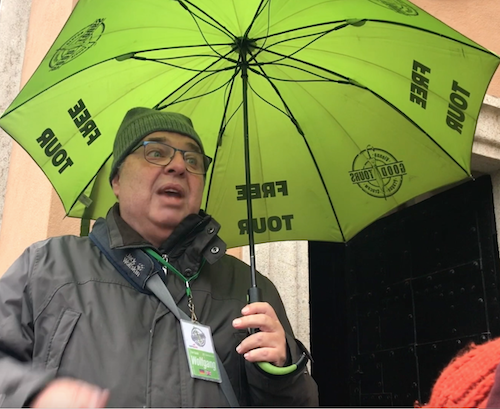
We should not have worried as our guide Wolfgang Rigon from Good Vienna Tours was a master storyteller, who kept us all captivated as he showed us the sights.
We stopped at least a dozen times as he told us a story, bringing alive the glorious and not so glorious history of the city. I recorded a couple of those stories on my phone. Have a watch of a powerful storyteller in action.
He must have told this first story about Marie Theresa, who gave birth to 16 children, hundreds of times. For us, the audience, his passionate delivery made us feel as if he was telling it for the first time.
First one is about Marie Theresa. See how he connects with the audience by making it relevant to the modern-day experience.
By Claire Doole, Doole Communications
Everyone loves a good story. Our parents read us stories, and we tell them naturally to friends and family. So why is it that in a professional context, we are so reluctant to tell stories?
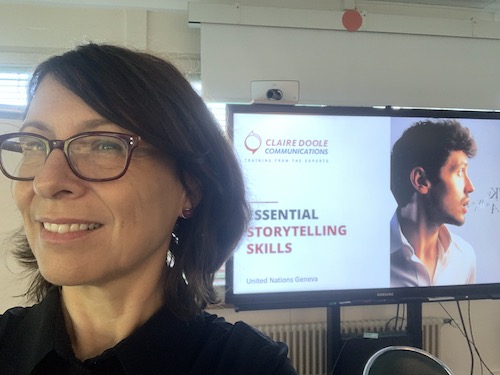
I ask this question at the start of my storytelling workshops. Participants come up with a number of answers ranging from it is culturally inappropriate, too personal or a lack of ability.
Often people tell me storytelling is too Anglo-Saxon and not appropriate in Mediterranean or other cultures. In fact, I would argue that Africans are fantastic storytellers due to their oral traditions. But I think this reluctance is because people associate storytelling with the high drama of Hollywood with its rollercoaster of emotions.
In fact, storytelling is much simpler; it is about adding colour to the facts.
Ethos, pathos, logos
The Greeks got it right 2,500 years ago. Aristotle said if you want to persuade someone of something, you need to appeal to ethos (credibility), logos (logic) and pathos (stirring emotion in the audience). In the workplace we often have ethos and logos, but shy away from pathos.
By Claire Doole, Doole Communications
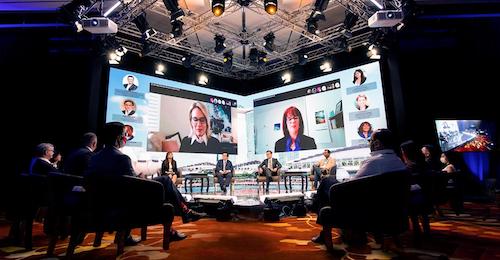
The pandemic is not over, but at least in Europe there is a return to something resembling normality (for the moment at least). At the virtual and hybrid conferences that I moderate, many speakers are talking about the small window of opportunity that exists to reset the world for the better of humanity.
But in my small world of moderating at events nothing much has changed – unfortunately!
I had hoped that some of the best practices from the virtual world – shorter event times, shorter presentations/speeches, greater variety of format and creativity – would become the new normal.
We know that we have to work harder to break through the screen of indifference when an event or meeting is virtual. The hybrid format – focusing on a virtual and in-person audience is challenging technically and editorially. I know some clients who have decided to abandon hybrid in favour of virtual or in-person.
However, editorially I am still seeing the same errors at some, not all, the events that I moderate. Here are some of them:
By Claire Doole, Doole Communications
Here in Geneva it is “la rentrée” – meaning back to school or back to work after the summer break.
For some it will be the first time they are back in the office after many months, while for others they may still be working from home.
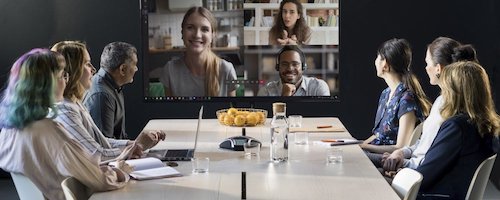
This means that hybrid meetings are de rigueur (order of the day) with some people meeting in person and others joining remotely.
Hybrid meetings should combine the best of both worlds, but the challenge is to make them inclusive and seamless.
Below are some tips and techniques for setting up and facilitating a hybrid meeting, based on my experience as conference moderator and conversations with organisers and technical suppliers.
Getting the equipment right
The higher the stakes, the higher the production values. A hybrid team meeting does not require the same level of equipment and resources as a townhall or stakeholder meeting. You may for example want to book a professional studio for a more important meeting, rather than set up a studio in your office. However, whatever the status of the meeting, you need to ensure that the online and in-person audience – the “Zoomies” and the “Roomies” can see and hear each other.
Audio equipment – The “Zoomies” join on their laptops or mobile devices that have inbuilt microphones, speakers and cameras, allowing the “Roomies” to see and hear them. Where it gets complex is ensuring the “Zoomies” hear the “Roomies”. “Roomies” need either dedicated microphones for each participant or another option is ceiling microphones which can pick up sound over a certain amount of space. I am no specialist on this, but I highly recommend you contact companies that install videoconferencing systems to ensure proper set up. I know of one organisation that held a hybrid meeting where the echo from the “Roomies” audio made the whole experience a waste of time and resources.
Visual equipment – You need a screen so that the “Roomies” can see the “Zoomies”.
In the room you also need a camera or camera(s), depending on the production values, focused on the entire room as well as the person who is speaking. These cameras are often automated and can zoom in and out on individuals speaking. This image is then relayed back to the online participants through a Zoom link (if that is the software you are using). More complex meetings require more cameras and a technical director who switches between cameras in the room.

By Claire Doole, Doole Communications
Have you seen the play, “Six Characters in search of an Author” by the Italian dramatist, Luigi Pirandello? Actors rehearsing for a play are interrupted by six unfinished characters in search of an author to finalise their story. It was first performed in 1921 and is part of the absurdist genre – breaking down the barriers between fantasy and reality.
Unfortunately, a century later, it is the absurd reality that many moderators can find themselves in when confronted with a cast of speakers selected by the organizers of an event. We struggle to work out why they have been chosen, and what they bring to the subject under discussion. We are then left to build connections between the speakers to create a narrative flow that makes sense to the audience.
Believe me, this can take hours of head scratching and sometimes the connections are just not there, particularly if an organiser has selected someone for non-editorial reasons such as an important donor, someone they want to do busines or engage with in the future or because we must have a representative from all five corners of the globe.
Start with the what and not the who
Organisers often tell me they want a BBC-style discussion. If that is the case, they need to follow the principles of BBC news and current affairs programmes. You start with identifying the news of the moment – for event organizers – this translates as what is top of mind and relevant for the audience.
A lot of events today are focusing on building back better after the pandemic, asking if the world can be more sustainable. The BBC would take an opposing view structure bringing someone from the government to explain how they set new environmental targets to achieve net-zero emissions, and then an environmental activist who says the targets are inadequate. The BBC might also put into the mix an academic who can give context.
- Melitta Campbell's new book out: A Shy Girl’s Guide to Networking
- Press briefings in the virtual world
- How to professionally produce a virtual event
- Hybrid events the new normal in 2021
- Moderating in the virtual world - Tips and techniques from a professional moderator
- Engaging Presenting in the virtual world
- Business Coach versus YouTube Mentors
- Successful virtual events are good television
- Expatriation the easy way or How I learned to give up my US citizenship and breathe freely again
- Streamlined Voluntary Disclosure for US citizens living in Switzerland
- Facilitating engaging meetings in the virtual world
- The power of virtual learning particularly in a pandemic
- 10 Tips for Moderating Dynamic Virtual Meetings
- Unprecedented pandemic press conference from pharma industry
- Business Success Secrets from a Local Business Coach for Women
- Storytelling is an essential professional skill
- How to Plan your Business for Success in 2020
- Creating a STAR panel discussion
- An end to "Manels" and "Manferences" - a Moderator's View
- Helena Rubenstein - Opportunity missed to tell the story of a great woman
- How to make your point the right way
- How to succeed at a video job interview
- Storytelling to further your career
- A job interview is a presentation
- The Perfect Career for Trailing Spouses?
- Avoiding Oscar Night Gaffes
- Is Davos the gold standard of panel discussions?
- Search Inside Yourself: born at Google and based on neuroscience
- Time in the market, not timing the market
- You Too Can Be A Powerful (TEDx) Public Speaker
- What Makes a Powerful TED Talk?
- Sunita meets one of the authors of "The Joy of Leadership"
- Building Rapport for Effective Communication
- Benefits of Next Generation Passive Investment Strategies
- Sunita talks to plant-based Chef Anou Boccasam
- Handling Question and Answer Sessions
- How to construct a memorable speech
- Motivational speeches: Take a lesson from football
- Sunita talks to yoga teacher, Céline Le Roux Schaer
- 6 top tips for an engaging panel discussion
- How Women Rise: Break The 12 Habits Holding You Back From Your Next Raise, Promotion Or Job
- An interview with Anne-Marie Struijk, Founder of La Maison de Tara
- How to craft a memorable sound bite
- Delivering powerful presentations
- Saving Swiss Public Service Broadcasting: Tips on structuring a persuasive speech
- An interview with Peter Wharton
- How to be prepared for market volatility – the importance of risk profiling explained
- How to reach your peak - an interview with Anders Ericsson
- Moderating with a Cartoonist
- Technology can transform your conference
- Hotel-Restaurant Valrose in Rougemont, Vaud - an interview with John Grohe
- Moderator, Facilitator and Master of Ceremonies: What is the Difference?
- “Pain is the agent of change,” Grief Works: Stories of Life, Death and Surviving
- Women and retirement – prepare in advance and be independent – just in case!
- Lessons from a Master Coach: What I learnt about public speaking from a musical maestro
- Sunita Sehmi talks to gender and inclusion specialist, Fleur Heyworth
- "Answer, don't avoid the question Prime Minister"
- Sunita Sehmi: interviewer and interviewee
- John Tomlinson talks to Sunita Sehmi about Trainer Tools, a collaborative podcast project for trainers
- The Local Media: Friend or Foe? How to constructively engage with local journalists
- Champion of women, food guru, inspirational entrepreneur: Pinky Lilani, the Ultimate Spice Girl
- How to moderate a hot topic
- Many Expats unaware their UK pensions have been affected
- Sharing happiness with Frederik Van Lierde, founder of Gift Voucher Kiosk
- How to sound natural when reading a speech
- The Entrepreneur's Wife: A Survival Guide
- The inaugural speech of Donald Trump: How persuasive was it?
- Happiness
- Moderating with Macron
- Find out more about abandonment recovery in Sunita Sehmi's interview with Susan Anderson
- Yogi banker brings corporate careers and holistic lifestyles together
- Find out more about Shakti Leadership in Sunita Sehmi's interview with Nilima Bhat
- Flexible working from the perspective of a Line Manager/Team Leader
- "Anyone can be a leader - it is a choice": an interview with Willem Jan Hofmans founder of YIELD
- Sunita Sehmi talks about The Work with Byron Katie
- Pension Protection Fund - is your pension safe?
- Tips for professional women during maternity leave
- The Ralda family talks to Sunita Sehmi about why sponsoring their olive trees makes a great Christmas present… that keeps on giving throughout the whole year.
- Capital Gains Tax for Non-UK Residents
- 5 key elements of a good LinkedIn profile picture
- QROPS and returning to the UK
- Transition to parenthood - tips for professionals pre-maternity leave
- Is Asia the place to be? Expat packages are highest in Japan, while pay levels in China keep rising
- Tools I use in my business
- Lifetime Allowance Protection
- Balancing parenthood with professional life
- Sunita Sehmi interviews one of Geneva's relocation agencies: Welcome Service
- The importance of the Lifetime Allowance in pension valuations
- Should I pay for a LinkedIn Premium Account?
- Personal tax measures announced in the Summer Budget
- Interview with Juliette and Michael McGannon, founders of the McGannon Health Group
- Another Greek Tragedy should give us all pause for thought
- What is wealth management and what can wealth managers do for you?
- Interview with Vladimir Kovin, founding partner of the Overcome The Barrier project
- Why social media is not working for you
- An interview with Yateendra Sinh, CEO of Lausanne Hospitality Consulting SA
- What’s the real price of oil?
- 5 small business habits to stop in 2015
- An interview with Tara Swart, CEO of The Unlimited Mind
- An interview with Remy Siegrist, President of Citizen of our World
Page 7 of 30