




Below you will find a selection of the most recent entries from bloggers in our Work/Business section.
To view the entries from individual bloggers, click on the links below:
- Claire Doole - Claire Doole Communications
Claire is a former BBC correspondent and international spokeswoman who is passionate about helping people communicate with confidence. Since 2006, she has successfully trained hundreds of professionals in the art of presenting and public speaking, talking to the media, managing communications in a crisis, and writing for the web. In addition, she has coached C-level executives and public figures to give powerful TEDx and TED style talks in Europe and the Middle East. A Swiss and UK national, Claire trains and coaches in French and English.
- Elizabeth Ballin - Life Coach
As a long time member of the international community in Geneva, Elizabeth Ballin has been coaching adults and students from all parts of the world. She has coached business professionals, musicians/artists, couples, families and adolescents. She is a fully accredited Life Coach by the International Coaching Federation. Elizabeth Ballin, Life Coach
- Patrick Hoza - US Tax & Financial Services
Since 1990, Patrick has many years of experience with US individual expatriate taxation under his belt, including High Net Worth Individuals, streamline/voluntary disclosure filings and tax consulting, as well as working with large multinationals like Novartis, BP, Hewlett Packard and General Electric. He has extensive knowledge in serving both US expatriates and resident and non-resident aliens with their US tax-related issues. Patrick Hoza is a Tax Director at US Tax & Financial Services, with extensive experience in all aspects of Individual US tax and Expatriation, including Hight Net Worth Individuals and large multinationals.
Patrick started his career in 1990 in California, with Westpro Ltd., as a Senior Tax Consultant, then spent the middle part of his career working at KPMG and Ernst & Young. During his time with Ernst & Young, he worked and lived in Russia, France and finally Switzerland. He has gained a valuable working knowledge of the respective income tax regulations in all of these countries.
Patrick holds a B.A. in International Relations from the University of Colorado, is a member of the National Association of Enrolled Agents and is a Certified Acceptance Agent.
-
Melitta Campbell - Business Coach
Business Coach and Mentor with nearly 3 decades of business experience and a passion for helping women confidently build a business they love. She is also the founder of the Swiss Entrepreneurs Club and president of the Swiss Riviera Toastmasters Club in Montreux. Originally from Wales, she now lives in Montreux in a chalet she has renovated with her husband overlooking the Swiss Alps. - Sunita Sehmi - Walk The Talk
Founder of Walk The Talk, Sunita has been training, developing and now coaching Business Communication skills in both companies and educational establishments for over twenty years. She has a passion for helping people to maximise their potential and created Walk The Talk with the sole aim to drive each and every client to perform their best.
- Robert Harris- Forth Capital
With over 25 years experience working for some of the major financial institutions in the City of London, Robert is a founding partner of Forth Capital, the leading expat financial advisory company in Switzerland. Regulary quoted in newspaper articles and magazines, he is well placed to advise expats on a variety of financial issues that may arise during their time living in Switzerland.
- Debbie Croft - Croft Coaching
As the founder of Croft Coaching, Debbie has a passion for helping people overcome challenges, embrace change and live life to the full; with an ethos of “work hard, play hard”.
- Sarah Santacroce, https://humane.marketing/coaching
Areas of Expertise: Conscious Business Coaching, Humane Marketing, LinkedIn
Sarah Santacroce is a Conscious Business Coach for Coaches and service-based solopreneurs, founder of Humane Marketing and author of Marketing Like We’re Human, Selling Like We’re Human, and Business Like We’re Human. Since 2006 in marketing, entrepreneurship, and conscious business coaching, she’s supporting changemakers worldwide through workshops, programs, and her signature Conscious Business Coaching. Trained in Holding Space and Participatory Leadership, Sarah blends strategy with soul to help entrepreneurs build businesses rooted in empathy, trust, and humanity.
Sarah has been a guest on nearly 100 podcasts and has been podcasting since 2016. Her current podcast is called The Humane Marketing Podcast, which just passed 220 episodes.
- Diana Ritchie - SSC Sàrl
A Director at Swiss Career Connections, Diana will provide you with some useful tips for job hunting.
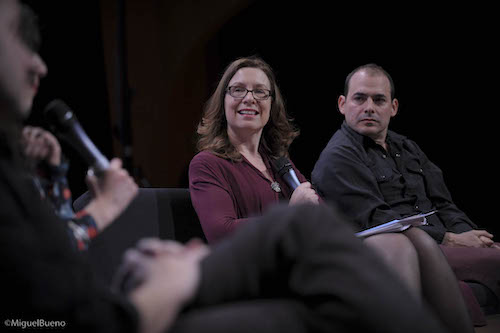
Photo: Miguel Bueno, Human Rights Film Festival
By Claire Doole, Claire Doole Communications
In everyday conversation, we often lead up to the point we want to make but when we are taking questions after a presentation, in a job or media interview then we want to do exactly the opposite!
Why is this? Because we want to be clear and concise and show with confidence we know the answer. And in a live broadcast interview, if the journalist suspects you are avoiding the question, they will interrupt and ask why you are not answering the question. So your reputation depends on getting to the point quickly.
Recently I watched some pre-recorded interviews done by CNN Money in Switzerland. As the Geneva Conventions turn 70, the programme asked whether this is a cause for celebration or concern? The reporter did 3 interviews with experts on whether the Conventions on respecting the rules of war are still relevant.
They illustrate 3 different ways of answering a question. Which one do you think is most effective?

By Claire Doole, Claire Doole Communications
As the adage goes, you don't get a second chance to make a first impression. But never has it been so true in these days of highly competitive job interviews where employers’ pre-screen candidates with a video interview.
According to the Institute of student employers, some 49% of interviewees are asked to do either a live face-to-face interview via video or one that is pre-recorded. In the latter, each candidate is given the same set of questions and timeframe to respond.
All video interviews whether for a job, a corporate video or for the TV can be nerve-wracking but the one-way video interview is particularly challenging, as you don't get any verbal or visual feedback.
Recently, a young woman came to me asking for advice on how to make a good first impression in a one-way video interview for a job she was applying for at an international organisation here in Geneva.
Here are some of the tips I gave her:

By Claire Doole, Claire Doole Communications
In presentation training, we focus on storytelling as a way of building emotional connection with the audience. Stories win hearts and minds, inspire and motivate and engage and entertain.
In a job interview, stories can be extremely effective. They will help you stand out in the interviewer's mind and highlight your key competencies.
Often, you will make a series of assertions such as I can help you increase sales, attract more funding or influence legislation. However, you will need to provide evidence for the interviewer to take you seriously. This is where stories, which are based on real-life examples, can help you come across as genuine and credible.
In my job interview coaching, we examine some typical questions, like the ones below, and apply storytelling techniques.
- Tell us about yourself.
- Why do you want to work for us?
- Why do you think you are the right person for this job?
- Tell us about a time you have succeeded/ failed.
- How do you deal with conflicts at work?
- Tell us what you don't like about your current working day?
- What sort of things do you and your boss disagree about?
- What is your greatest strength and how will it help you in this job?
- What do you see as the most challenging part of this position?

By Claire Doole, Claire Doole Communications
Every conversation is a presentation, and no conversation has higher stakes than a job interview. To succeed, you need to convince a potential employer you are the right person for the job.
Over the past year, I have been coaching people in the art of the effective job interview - with a 100% success rate so far. This is probably due to the fact that so many aspects of presenting yourself to a future employer rely on presenting and public speaking skills - my areas of expertise.
Here are some tips essential to effective presenting that can be applied to the job interview
Put your self in the shoes of the your audience
Look at every question from the employer’s perspective and do your homework. This means doing a detailed research of the company and what their needs are both today and in the future. With this information, you can explain your assessment of their challenges and opportunities and why you can help them meet them.
For example, when asked why are you interested in the job, you could reply:
"I've had twelve years in customer service positions, with four years managing the whole department. Your position clearly demands a strong service component in areas where I have expertise."
© Marta Villacampa, Family Photographer, Gland
By Melitta Campbell www.melittacampbell.com
Being a trailing spouse can be an exciting and enriching experience. You get the chance to not only visit a new country, but to live and experience its people, culture and language on a deeper level than you ever would as a tourist. Exciting as this is, as a trailing spouse myself, I know that it can also be frustrating, lonely and isolating!
One of the biggest frustrations can be finding work. In a land where you don't know the culture, speak the language or have a network, finding employment is no easy task. Being away from friends and family, and having no clear direction or purpose, can lead you to lose confidence in yourself and your abilities – which certainly does not help the job-seeking process!
Since moving to Switzerland 15 years ago, I’ve discovered that I’m not alone in feeling the excitement, but also the frustrations of expat life. That’s why I wanted to share what’s worked well for me, in case it could be the perfect career solution for you as well – becoming my own boss.
My experience of running a business as an expat
When I started out on my own 11 years ago, I barely spoke the local language, I had a small network and I had no experience of running my own business. I also had a bonnie 5-month old baby on my hands!
Starting my own business was not the easy choice. But today, I’m proud of the confident businesswoman I’ve grown into, as well as the many other women I’ve helped to launch their own successful business too.
I’ve seen first hand that even if you have little or no experience, it is very possible to start a business here – if you have courage to commit to your dream and take the first step.
Here’s why I feel owning your own business can be a great work option for trailing spouses…
- Avoiding Oscar Night Gaffes
- Is Davos the gold standard of panel discussions?
- Search Inside Yourself: born at Google and based on neuroscience
- Time in the market, not timing the market
- You Too Can Be A Powerful (TEDx) Public Speaker
- What Makes a Powerful TED Talk?
- Sunita meets one of the authors of "The Joy of Leadership"
- Building Rapport for Effective Communication
- Benefits of Next Generation Passive Investment Strategies
- Sunita talks to plant-based Chef Anou Boccasam
- Handling Question and Answer Sessions
- How to construct a memorable speech
- Motivational speeches: Take a lesson from football
- Sunita talks to yoga teacher, Céline Le Roux Schaer
- 6 top tips for an engaging panel discussion
- How Women Rise: Break The 12 Habits Holding You Back From Your Next Raise, Promotion Or Job
- An interview with Anne-Marie Struijk, Founder of La Maison de Tara
- How to craft a memorable sound bite
- Delivering powerful presentations
- Saving Swiss Public Service Broadcasting: Tips on structuring a persuasive speech
- An interview with Peter Wharton
- How to be prepared for market volatility – the importance of risk profiling explained
- How to reach your peak - an interview with Anders Ericsson
- Moderating with a Cartoonist
- Technology can transform your conference
- Hotel-Restaurant Valrose in Rougemont, Vaud - an interview with John Grohe
- Moderator, Facilitator and Master of Ceremonies: What is the Difference?
- “Pain is the agent of change,” Grief Works: Stories of Life, Death and Surviving
- Women and retirement – prepare in advance and be independent – just in case!
- Lessons from a Master Coach: What I learnt about public speaking from a musical maestro
- Sunita Sehmi talks to gender and inclusion specialist, Fleur Heyworth
- "Answer, don't avoid the question Prime Minister"
- Sunita Sehmi: interviewer and interviewee
- John Tomlinson talks to Sunita Sehmi about Trainer Tools, a collaborative podcast project for trainers
- The Local Media: Friend or Foe? How to constructively engage with local journalists
- Champion of women, food guru, inspirational entrepreneur: Pinky Lilani, the Ultimate Spice Girl
- How to moderate a hot topic
- Many Expats unaware their UK pensions have been affected
- Sharing happiness with Frederik Van Lierde, founder of Gift Voucher Kiosk
- How to sound natural when reading a speech
- The Entrepreneur's Wife: A Survival Guide
- The inaugural speech of Donald Trump: How persuasive was it?
- Happiness
- Moderating with Macron
- Find out more about abandonment recovery in Sunita Sehmi's interview with Susan Anderson
- Yogi banker brings corporate careers and holistic lifestyles together
- Find out more about Shakti Leadership in Sunita Sehmi's interview with Nilima Bhat
- Flexible working from the perspective of a Line Manager/Team Leader
- "Anyone can be a leader - it is a choice": an interview with Willem Jan Hofmans founder of YIELD
- Sunita Sehmi talks about The Work with Byron Katie
- Pension Protection Fund - is your pension safe?
- Tips for professional women during maternity leave
- The Ralda family talks to Sunita Sehmi about why sponsoring their olive trees makes a great Christmas present… that keeps on giving throughout the whole year.
- Capital Gains Tax for Non-UK Residents
- 5 key elements of a good LinkedIn profile picture
- QROPS and returning to the UK
- Transition to parenthood - tips for professionals pre-maternity leave
- Is Asia the place to be? Expat packages are highest in Japan, while pay levels in China keep rising
- Tools I use in my business
- Lifetime Allowance Protection
- Balancing parenthood with professional life
- Sunita Sehmi interviews one of Geneva's relocation agencies: Welcome Service
- The importance of the Lifetime Allowance in pension valuations
- Should I pay for a LinkedIn Premium Account?
- Personal tax measures announced in the Summer Budget
- Interview with Juliette and Michael McGannon, founders of the McGannon Health Group
- Another Greek Tragedy should give us all pause for thought
- What is wealth management and what can wealth managers do for you?
- Interview with Vladimir Kovin, founding partner of the Overcome The Barrier project
- Why social media is not working for you
- An interview with Yateendra Sinh, CEO of Lausanne Hospitality Consulting SA
- What’s the real price of oil?
- 5 small business habits to stop in 2015
- An interview with Tara Swart, CEO of The Unlimited Mind
- An interview with Remy Siegrist, President of Citizen of our World
- Professional networking - Part 2:
- Professional networking - Part 1
- An interview with Andy Puddicombe, meditation and mindfulness expert, and co-founder of Headspace
- Tax: The hidden dangers and what you can do about them
- An interview with Manor Directors, Magdalena Boos and Jean-Louis Bornet
- An interview with Richard Gerver by Sunita Sehmi at Walk The Talk
- 'Riding a bike is like life, you have to keep moving"...
- LinkedIn opens publishing for everyone
- Nada Kakabase outlines latest findings on compulsive internet use
- Some tips for delivering bad news
- Sarah Santacroce's LinkedIn Connection Strategy
- In Praise of Praise
Page 12 of 30